

Most wholesale buyers specify a plush toy’s fabric, color, and size in detail, then leave the stuffing to “whatever the factory normally uses.” That gap is where a surprising number of quality complaints originate. Plush toy stuffing is not a single, uniform material — it is a variable that a factory adjusts by density, fiber grade, and fill pattern to hit a specific hand feel and shape outcome.
Get it wrong and you end up with one of two complaints from your own retail buyers: the toy felt great on arrival but went saggy and lost its shape after a few weeks on the shelf, or the toy felt hard and overstuffed straight out of the bag, more like a cushion than a plush companion.
Both problems are avoidable, and both come down to decisions made before cutting even starts: how much PP cotton stuffing plush fill goes into each panel, what fiber grade is used, and how that fill is expected to behave under the toy’s specific size, posture, and compression conditions. This article breaks down what actually controls plush toy stuffing firmness, how to match firmness to your product type, and how to brief your factory so the sample you approve is the same hand feel you receive in bulk.
The B2B Buyer Problem: Too Soft Loses Shape, Too Firm Feels Cheap
This is the most common stuffing-related complaint we hear from importers after a bulk shipment lands. A plush toy that is under-filled or filled with low-recovery fiber will look correct in the sample but flatten, sag, or develop lumps after handling, transit compression, or a few weeks on a warehouse shelf — the ears droop, the belly caves in, ears or limbs lose their intended silhouette. On the opposite end, a plush overstuffed with a dense or low-quality fiber feels stiff and unyielding, more like a firm cushion than a soft toy, and can even stress seams during shipping compression, leading to split seams after the carton is unpacked.
Both outcomes trace back to the same root issue: plush toy stuffing firmness was never explicitly specified or tested against the product’s actual size and posture before bulk production started. “Soft and cute” is not a specification a factory can engineer against — density in grams, fiber grade, and fill pattern are.
What Actually Determines Plush Toy Stuffing Firmness
Firmness is not one variable — it is the combined result of five factory-controlled decisions. Understanding each one lets a buyer brief a factory precisely instead of relying on a vague “make it soft but not too soft” instruction.
Stuffing Density
Density is the fill weight packed into a given volume of the toy, typically measured in grams of PP cotton stuffing plush fill per cubic unit of finished plush. A 30 cm plush filled at a light density (roughly 90–110 grams) will feel loose and floppy; the same 30 cm plush filled at a firm density (170–190 grams) will feel dense and structured. Density is set panel by panel — a factory can specify a firmer fill in the body for shape stability and a lighter fill in the ears or tail so those parts still move and drape naturally.
PP Cotton Quality and Fiber Grade
Not all PP cotton stuffing plush fiber is equivalent. Fiber is graded by denier (fiber thickness) and structure — hollow conjugate fiber traps more air and recovers its shape faster after compression, while solid fiber is denser and cheaper but compresses flat more easily and recovers more slowly. Virgin PP cotton holds loft and bounce-back significantly longer than recycled or reprocessed fiber, which tends to mat down after repeated compression cycles during shipping and handling.
Product Size
Firmness is not size-independent. The same density that feels appropriately soft on a 15 cm keychain plush will feel under-filled and shapeless on a 45 cm floor plush, because larger surface areas need proportionally more structural support to hold silhouette under their own weight. Factories scale fill weight non-linearly with size — larger plush typically need a higher density ratio, not just a higher total fill weight, to avoid sagging under gravity.
Sitting Posture and Structural Requirements
A plush designed to sit upright on a shelf needs a different internal structure than one designed purely for hugging or hand-holding. Sitting or standing plush typically require a firmer, sometimes weighted base (PP cotton combined with PP pellets or a plastic base insert) to hold posture without tipping, while the upper body can remain softer for hand feel. Skipping this distinction is one of the most common causes of plush that photograph well in a flat sample but topple over or slump on a retail shelf.
Compression Recovery
Compression recovery is how well the fiber regains its shape after being squeezed — during a customer’s hug, during warehouse stacking, or during the transit compression a carton experiences in a shipping container. Low-recovery fiber stays flattened after pressure is removed, which is what produces the “lost its shape after a few weeks” complaint even when the original plush toy stuffing density was correct. Recovery performance is a fiber-grade property, not a density property, which is why simply adding more low-grade fiber does not fix a shape-retention problem.
Plush Toy Stuffing Firmness Comparison by Application
Different product types call for different plush toy stuffing firmness targets. The table below reflects the density and fiber choices we apply as starting points for common custom plush applications, adjusted per project based on fabric type and final size.
| Application | Recommended Firmness | Typical Density (30cm ref.) | Fiber Type | Hand-Feel Result |
| Handheld / sleep companion | Soft-medium | 110–140 g | Hollow conjugate, 7D | Squeezable, conforms to grip |
| Shelf / display plush | Medium-firm | 150–170 g | Hollow conjugate, 15D | Holds silhouette upright |
| Seated plush with base | Medium body / firm base | 140 g body + weighted base | PP cotton + PP pellets | Stable seated posture, no tipping |
| Keychain / mini plush | Firm | 35–45 g (15cm ref.) | Solid fiber, 3D | Compact, resists sagging under hardware |
| Collector / licensed plush | Medium-firm, consistent | 150–160 g | Silicone-coated hollow fiber | Uniform shape across production batches |
Table 1: Stuffing firmness reference by product application (30cm plush used as sizing reference unless noted).
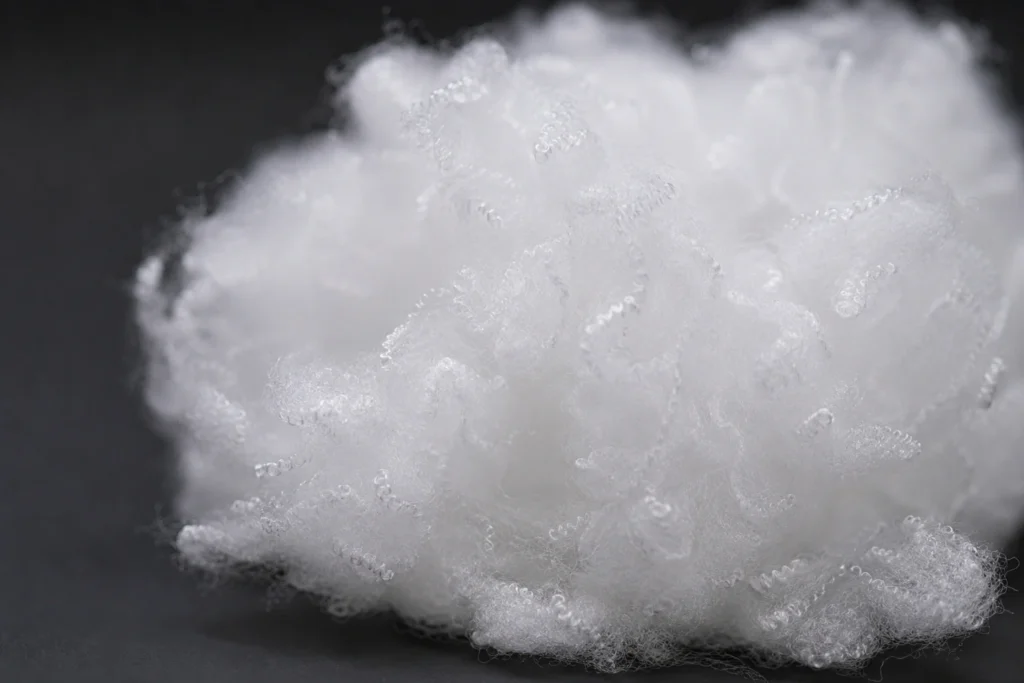
Fiber grade selection has a direct, testable effect on custom plush hand feel and on how long a plush toy holds its shape after repeated handling. The comparison below outlines how different PP cotton stuffing plush grades perform under compression.
PP Cotton Stuffing Plush: Fiber Grade Comparison
| Fiber Grade | Denier | Structure | Bounce-Back Speed | Best Use Case |
| Standard solid fiber | 3D–6D | Solid core | Slow, partial recovery | Budget mini plush, low-handling items |
| Hollow conjugate fiber (HCS) | 7D–15D | Hollow, spiral-crimped | Fast, near-full recovery | Huggable plush, mid-to-premium lines |
| Silicone-coated hollow fiber | 7D–15D | Hollow, silicone-treated | Fast, consistent across batches | Licensed / collector plush requiring shelf consistency |
| Recycled PP cotton | Varies | Reprocessed, shorter staple | Slow, degrades with repeat compression | Cost-driven programs, lower handling frequency |
Table 2: Fiber grade characteristics and where each performs best in a custom plush program.
Compression Recovery and Shape Retention
Compression recovery is tested by compressing a filled sample to a fixed percentage of its original loft, holding it, releasing it, and measuring how much loft returns after a set recovery period. This is the single best predictor of whether a plush toy will still look correct after the transit compression of ocean freight and months on a retail shelf.
| Fiber Type | Recovery After 24h Compression | Recovery After 500 Compression Cycles | Expected Shelf Shape Retention |
| Standard solid fiber | 75–80% | 55–60% | 3–4 months before visible sagging |
| Hollow conjugate fiber (HCS) | 90–95% | 80–85% | 9–12 months with stable shape |
| Silicone-coated hollow fiber | 95–98% | 88–92% | 12+ months, minimal visible change |
| Recycled PP cotton | 65–75% | 45–55% | 2–3 months before flattening is visible |
Table 3: Compression recovery performance by fiber type, based on standard internal fill-loft testing.

Fiber grade and density are not the only cost variables buyers should weigh. Firmness also changes how much space a finished plush occupies in a shipping carton, which has a direct effect on landed cost per unit.
Custom Plush Hand Feel vs. Shipping Volume: What Buyers Should Know
A firmer, higher-density PP cotton stuffing plush fill holds its shape better but compresses less inside a carton, which can increase cubic volume per unit and raise freight cost. A softer, lower-density plush compresses more efficiently for shipping but carries a higher risk of shape loss on arrival if the fiber grade is not matched correctly. The table below illustrates this trade-off using a 30cm reference plush.
| Firmness Level | Fill Weight (30cm ref.) | Compressed Carton Volume Impact | Freight Cost Impact | Shape Stability Risk |
| Light / soft | 90–110 g | Compresses well, lower cubic volume | Lower per-unit freight cost | Higher risk of sagging if fiber grade is low |
| Medium (recommended default) | 130–150 g | Moderate, balanced volume | Moderate freight cost | Low risk with hollow conjugate fiber |
| Firm / dense | 160–190 g | Compresses less, higher cubic volume | Higher per-unit freight cost | Very low risk, best shelf consistency |
Table 4: Firmness-to-freight trade-off. Actual figures vary by fabric type, panel construction, and carton packing method.

Structural Stuffing for Sitting and Standing Plush
Plush toys intended to sit upright on a shelf, stand independently, or hold a specific pose need internal structure beyond uniform PP cotton stuffing plush fill. This typically means a weighted or firmer base — PP cotton blended with PP pellets, a stiffened base panel, or in some cases a plastic base insert — paired with a softer upper body fill so the toy still feels approachable to hold. Specifying “soft” fill throughout a seated character is one of the most common briefing errors we see, and it is the direct cause of samples that look correct lying flat but slump or tip over once displayed upright.

Stuffing Firmness Selection Checklist for Wholesale Buyers
Use this checklist when briefing a factory on plush toy stuffing firmness, or when reviewing a pre-production sample to confirm the custom plush hand feel before bulk fill begins.
| Check Item | What to Confirm | Status |
| Fill density specified | Target grams per unit documented for each size, not left to factory default | ☐ |
| Fiber grade confirmed | Hollow conjugate or silicone-coated fiber specified for huggable/display items | ☐ |
| Panel-by-panel fill plan | Firmer base/body vs. softer ears/limbs mapped where applicable | ☐ |
| Posture requirement addressed | Seated/standing items have a defined weighted-base structure | ☐ |
| Compression recovery tested | Sample tested for loft recovery after compression, not just first-touch feel | ☐ |
| Shipping volume reviewed | Firmness level checked against carton cubic volume and freight cost target | ☐ |
| Bulk consistency plan | Fill weight tolerance range documented for QC to check during mass production | ☐ |
Table 5: Pre-production stuffing firmness checklist to confirm before bulk fill begins.

Buyer Takeaway
Plush toy stuffing firmness is not a matter of taste — it is a specification made up of PP cotton stuffing plush density, fiber grade, product size, posture requirements, and compression recovery, and every one of those variables can be documented and tested before bulk production starts. Buyers who specify fill density and fiber grade in their tech pack, rather than describing a general “soft but sturdy” feel, get a custom plush hand feel that matches their approved sample consistently across the full production run.
Avoid the two most common complaints in plush sourcing: shape loss after a few weeks, and a hand feel that reads as cheap or overstuffed. Reviewing stuffing specifications with the same rigor applied to fabric and stitching is one of the highest-leverage, lowest-cost checks available before committing to a bulk order.
NOT SURE WHICH STUFFING FIRMNESS FITS YOUR PRODUCT?
Ask Us to Recommend Stuffing for Your Product. Share your plush size, posture (huggable, seated, or display), and target hand feel, and our pattern and production team will recommend a fill density and fiber grade before your sample is cut.
Ask Us to Recommend Stuffing for Your Product
Frequently Asked Questions
What is PP cotton stuffing and why is it the standard for plush toys?
PP cotton (polypropylene cotton) is a synthetic fiber fill valued in plush toy stuffing for its light weight, washability, hypoallergenic properties, and consistent availability at scale compared to natural fill alternatives. Fiber grade and structure, not the base material itself, are what most affect the final firmness and recovery performance.
Can I request a specific fill density if I don’t know the technical terminology?
Yes. The most reliable approach is to approve a physical sample at your target firmness and ask the factory to document the fill weight and fiber grade used in that sample as the production standard, rather than trying to specify density figures from scratch.
Does stuffing firmness affect fabric choice, or are they independent decisions?
They are related. Longer-pile or stretch fabrics can visually mask minor fill inconsistencies, while short-pile or smooth fabrics show fill unevenness more readily, which means firmer, more consistent fill is generally recommended for smooth-fabric plush.
Is firmer stuffing always more expensive?
Not necessarily on a material cost basis, but firmer, higher-density fill does increase both material usage and finished carton volume, which can raise per-unit freight cost even if the fiber grade itself is the same price.
How do I know if a sample’s firmness will hold up after shipping, not just on arrival?
Ask the factory for compression recovery data or request a compression test on the pre-production sample. First-touch softness on a fresh sample does not confirm how the fiber will perform after container transit and warehouse handling.


